
Hole and dent repair
Doorknob holes, old anchor and fixture holes, furniture dents. Patched flush and feathered so the spot cannot be found.
See how we handle itServing Altoona and Blair County
We mend the walls and ceilings of old railroad-city houses so the repair is still invisible after the next mountain winter.
The three reasons people ring us:
The first look
Some mornings you walk down the hall, notice a line in the wall you have not seen before, and wonder whether to worry. Most of the time the answer is a calm one. Here is how we sort it.
A ceiling that is soft to the touch, sagging, or still damp. A stain that grew since you last looked. Plaster that sounds hollow and flexes when you press near a crack. Any open wall where wiring or pipe is exposed and the house is occupied.
A hairline running up from a window corner that has not moved in a season. A single popped nail head. A dent behind a door where the knob keeps landing. A patch from years ago that has gone slightly proud under the paint.
What we mend
Old houses fail in a handful of repeating ways. We have sorted the work into five, and each has its own page with the details.
Doorknob holes, old anchor and fixture holes, furniture dents. Patched flush and feathered so the spot cannot be found.
See how we handle itHairline and deep cracks, loose or bulging plaster, and blending old plaster with later drywall patches.
See how we handle itClosing up walls and ceilings opened for wiring, plumbing, ductwork or windows so the repair disappears.
See how we handle itRoof leaks, winter ice-related leaks and bathroom leaks from above. We cut out damaged material and rebuild.
See how we handle itRecurring cracks over doors and windows, popped fasteners in later drywall additions, and dented or cracked corner bead.
See how we handle itThe house
Stand on a street in Juniata at the end of a winter afternoon and you can read the town in the brickwork. Altoona was laid out in 1849 by the Pennsylvania Railroad, and it grew up around the work of moving trains over the Allegheny Mountains. The houses came with it, quickly and in rows.
Altoona was founded in 1849 and incorporated as a city in 1868. Census-derived estimates put the median house here near the mid-1940s, which means a typical Altoona wall was built before drywall was the default. Plaster over wood lath was the norm, and drywall arrived later as patches, additions and remodeled rooms. The consequence for you is that one wall often holds two materials that move differently, and a crack can run along the seam between them.
The city sits in the Allegheny Mountains, so houses here cycle through hard cold and wet thaws every year. Wood framing swells and shrinks with that cycle, and rigid plaster and taped joints show it first. That is why a crack over a door can close in July and reopen in January, and why we look for movement before we fill anything.
Older districts mix rowhouses with individual homes, the way many railroad towns did when they housed workers and managers side by side. A rowhouse shares party walls and often has narrow stair halls, so a patch near a neighbor's wall deserves care about noise, dust and how a fix is finished on both faces.
About 64 percent of homes in Altoona are owner-occupied, according to Census QuickFacts. People here tend to keep a house and improve it, which is why so much of our work follows plumbers, electricians and window crews. The wall should look as if nobody ever cut into it.
Tell us what you are looking at and attach nothing more than a description for now. A photo helps when we call back, and if you can say whether the wall is plaster or drywall, that saves a step.
Questions
Very likely. Tap the wall with a knuckle: plaster gives a dense, solid sound, while drywall sounds lighter and a little hollow. Plenty of old Altoona houses have both, because rooms were patched or added over the decades. Tell us what you find, or say not sure, and we will confirm when we look.
Usually, yes. A good repair is feathered wide enough to disappear, and then the paint is blended to the nearest natural break such as a corner or a ceiling line. Where the old paint has aged unevenly, we will tell you honestly if a whole wall needs a fresh coat to look right.
Because it was a symptom, not the whole problem. In a house that swells and shrinks with mountain seasons, a crack over a door or window often follows a seam or a stress line. We reinforce those spots with tape or mesh and a flexible build so the repair moves with the house rather than against it.
Treat it as a message. A dry, old, unchanging stain is a lesser worry than a damp or growing one, but all of them mean water got in once. Find the source first. We cut out wet or damaged material and rebuild the ceiling, and if you suspect mold, a qualified specialist should look at it before we close anything up.
That is a big share of what we do. We can come in after the rough work is inspected, close up the walls and ceilings, and finish them to match. Tell us what is being opened and when, and we will line the patch up with the rest of the schedule.
Use the Send Photos page. Give us a few pictures from a step back and a few close up, a sentence about what happened, and the town. We read every one and come back to you by call or text.
In the field
One owner had painted over the same crack above the bedroom door three times. Each spring it disappeared; each winter it was back, running diagonally up to the ceiling. The plaster on one side of it was loose from the lath and had been, quietly, for years. Fixing it meant reattaching the loose plaster first, then bridging the line so the surface could move a little without showing.
A family had new wiring run through the second floor. The electrician left neat, square openings in the plaster, each patched with a scrap of drywall and a handful of screws. Within a week the patches showed as slightly raised rectangles under the paint, because drywall is thinner than old plaster. We rebuilt each opening flush with the surface around it.
She noticed it one morning with her coffee: a pale brown stain the size of a dinner plate above the bathroom door, with a faint edge like a map. The roof was not the cause this time. A supply line upstairs was weeping. The plumber stopped it, and we cut the soft ceiling back to solid material, rebuilt it, and primed it with a stain-blocking coat.
Straight talk
The crew
A repair starts at your front door, not in the truck. We walk the room and look at the wall from across it, because a long view shows flexing and waves that a close view hides. Then we press, tap and sight along the surface and decide what it is made of.
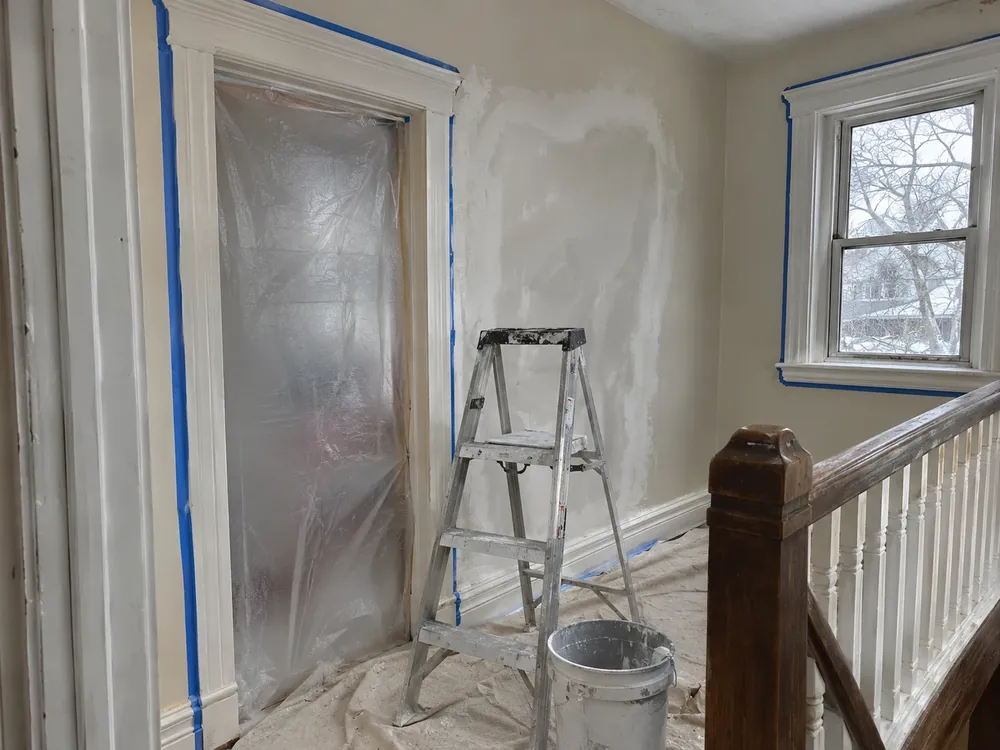
We protect the floor and furniture first, and we sand with dust control because old houses already carry enough dust. Patches are built in thin coats and feathered wide, sanded between coats, and primed before paint. Nothing is rushed to hit a clock. A fast patch in a winter house tends to come back by spring.
We tell you what we see, including when a wall needs a different trade before it needs us. That can mean a roofer, a plumber or a specialist for suspected mold. We would rather say so than patch over a problem.
The sequence
The method
The cause of the crack or stain is part of the job. We trace it before we fill it.
Repairs are made in several light coats, which is how a patch stays invisible.
Floors and furniture are covered, dust is controlled, and the work area is left swept.
If the real fix belongs to a roofer, plumber or specialist, we tell you plainly.
Before we meet
A few minutes with your phone and a flashlight make the repair quicker and the first conversation more useful. We wrote down what to photograph, what to measure, what to shut off and what to note about an old wall, so you can do it standing in the hallway.
The map
We work in Altoona and the towns around it. The full list, with a line on each, is on the towns page.
A neighborhood tied to the railroad's shops, with a lot of older, closely built houses where original plaster is common.
Older commercial and residential blocks, including upstairs apartments and rowhouse-style buildings where walls were patched over many decades.
Neighborhoods that grew with the railroad and were later brought into the city, with a mix of rowhouses and detached homes.
The Blair County seat, a short drive south, with a large stock of older homes and an historic center.
A borough just south of Altoona where older houses sit alongside later builds, so walls often mix materials.
A small borough north of Altoona with older homes and the plaster that comes with them.
Maybe it has been a crack for a winter, a stain for a month, or an open hole since the electrician left. Either way, send what you have and we will go from there.